Chicory is the step-child in the universe of coffee purism. Some purists may react by saying that the Robusta bean is the step-child (more on this later) – which, would make chicory the dark sheep of the coffee universe? At this point, we would all agree that one of the many roads to hell is paved with labored metaphors and labels.
Suffice to say that here in India chicory is somewhat controversial. You feel like you need to look down upon it to be considered a person with good tastes – but damn does it make for a delicious cup of coffee! Think of it as Tyrion within the Lannister family. (I promise I am done with these comparisons!)
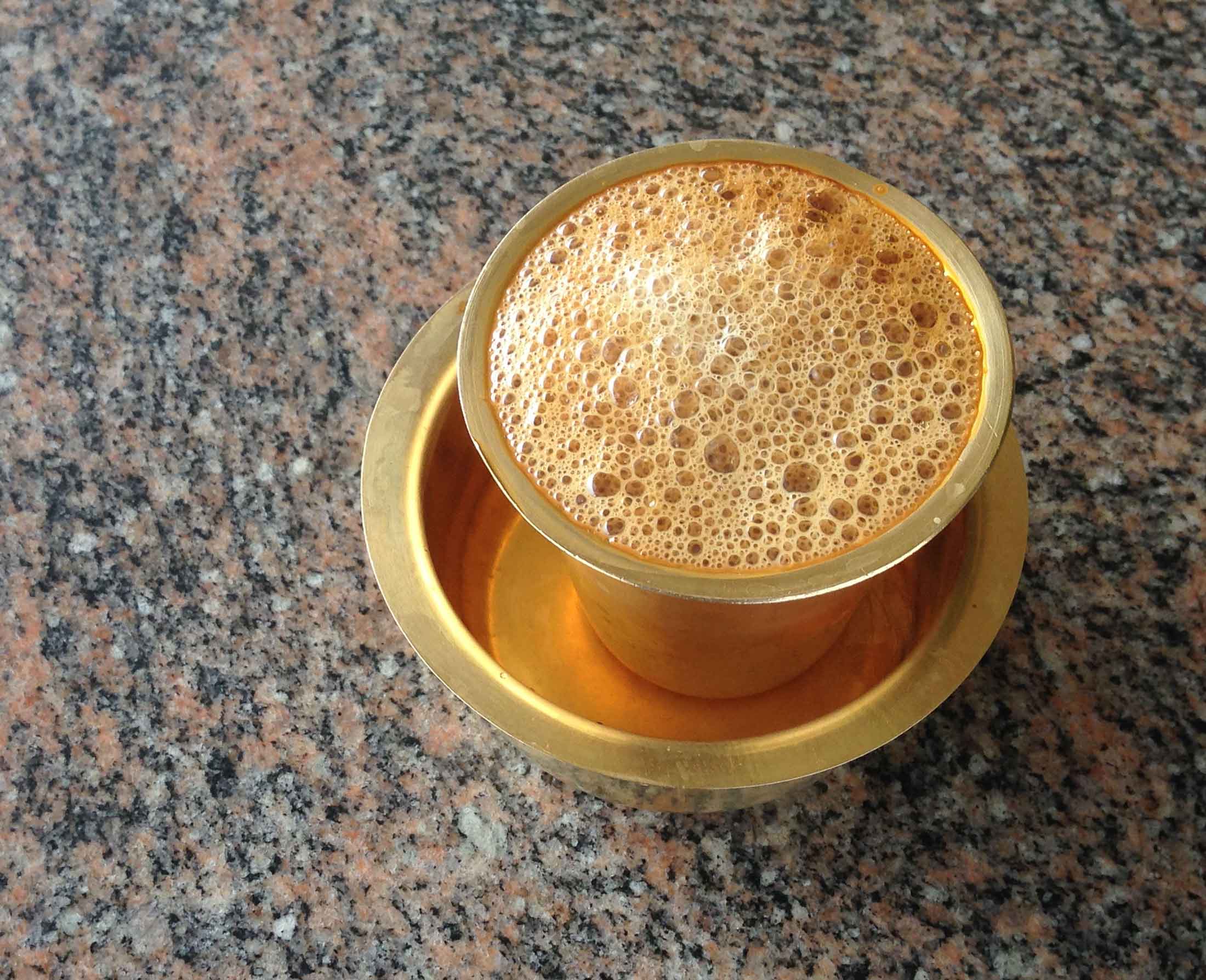
If you’ve ever had South Indian filter coffee (SIFC) then you’ve probably already had chicory. SIFC powders that you get in the market typically are a blend of coffee and chicory powders. The percentage of chicory can vary between 5-45%. Some brands declare the ratio on the pack – but not all do.
Growing up in a South Indian household, I was given the impression that chicory was a necessary evil – an adulterant in “pure” coffee to make the drink stronger. “We don’t buy coffee with too much chicory. Our powder has just 15% chicory,” a grand-uncle once told me, as we took a sip of coffee together.
This skepticism has deep roots, and to understand it we must first understand a few dominant principles in the coffee world.

By Original book source: Prof. Dr. Otto Wilhelm Thomé Flora von Deutschland, Österreich und der Schweiz 1885, via Wikimedia Commons
Arabica and Robusta
First, there are two types of coffee beans that are sold commercially in the world – Arabica and Robusta.
Arabica beans are the premium variety. They are high on complex flavor compounds, have decent caffeine content, and lower amounts of the bad bitter compounds.
Robusta beans are more bitter, contain fewer complex flavor compounds, but they have higher caffeine when compared to Robusta (hence, “step-child”).
Purists have their coffee black with premium grade 100% Arabica beans. This is considered the gold standard. No one sells coffee powder made with 100% Robusta beans. (If they do I recommend you steer clear of such products – unless burnt rubber is the flavor you were going for.) However, Arabica+Robusta blends are commonly sold, and, in my opinion, make for a good cup of coffee.
A Wartime Substitute
While purists may tolerate Arabica+Robusta blends, chicory is considered an adulterant and downright frowned upon. There is truth to this assertion. After all, chicory is not coffee. It is a flowering plant and belongs to the dandelion family. Its fleshy white root is dug up, roasted, ground, and mixed with coffee powder to create a coffee+chicory blend.
In Europe and in the US, people turned to chicory when war disrupted coffee supply lines. Chicory was not the only substitute experimented with. There are records of people roasting chickpeas, cereals, and vegetables like beetroot to stretch their supplies of coffee!
In the book, Coffee and Chicory (1864), author P.L. Simmonds dedicates an entire chapter to coffee adulterants. He points out that bags of husks of peas, cobs of Indian corn, wheat, sea-biscuits and other articles, have no place in a coffee mill. In typically British fashion, Simmonds tries to be polite even as he disses on the adulterants.
It will not be denied that the husks of peas or the cobs of maize are appropriately placed in the trough from which our pigs feed; they will even add to the delicacy and whiteness of the pork those very useful animals are intended to yield us, but they are essentially out of place in our coffee-cup
Chicory: An Adulterant?
Interestingly, Simmonds doesn’t include chicory in the list of adulterants. But there are others that did. The entry on chicory in the Cyclopaedia of India And of Eastern and Southern Asia (1857) makes a reference to the Chambers’s Edinburgh Journal which states that “chicory must be regarded altogether as an adulterant”. The cyclopaedia also recommends a technique to find out if chicory is mixed with coffee.
The presence of chicory may be detected in coffee by putting a spoonful of coffee gently into a tumbler of clear cold water: if pure it will float on the surface; if not the chicory will separate and discolor the water as it subsides.
However, the market didn’t seem to care. According to Simmonds, France exported 1.25 million pounds of chicory in 1835. By 1860, they were exporting 16 million pounds per year. Ironically, this huge demand led to adulteration of chicory!
The great demand for chicory has led to extensive adulteration; first by what is called Hambro powder, which consists of roasted and ground peas, damaged corn &c. colored with Venetian red; and secondly by coffee flights , the thin membrane which separates from coffee seeds in the act of roasting.
Cyclopaedia of India And of Eastern and Southern Asia (page 340)
Parsnips and turnips too were roasted and used as substitutes for chicory.
The Counter View
What does the demand for chicory and its subsequent adulteration tell us? Chicory may have been added to coffee grounds to increase coffee volumes while supplies were low, but it clearly added something that was pleasing to the human palate.
According to Simmonds, the coffee-chicory mix probably had its origin in Holland, and was introduced in France at the beginning of the 19th Century. It was from there that chicory became popular.
Of course, the French were open to more experiments – adding roasted acorn and beetroots to their coffee mix. Simmonds mentions a recently introduced drink in France called ‘cafe de betterave’. The French believed that beetroots lent their nutrients and sweetness to coffee. The coffee+chicory mix was called ‘cafe de chicoree’.
In The History of Coffee Including a Chapter on Chicory (1850), author William Law describes just what chicory adds to coffee.
The truth seems to be,that Coffee is not what people call Coffee, unless a certain quantity of Chicory be prepared along with it; and it is rather remarkable that the world has been so long in getting at this fact. The Chicory seems to give body to the Coffee. It gives it also depth of colour; but that is nothing. It fortifies the quality of thinness in the Coffee, imparts that softish and pleasing aroma which makes the beverage acceptable.
What’s The Verdict?
This description of chicory solved a vexing puzzle in my head. Ten years ago, I wrote an article on the science of brewing the perfect cup of filter coffee. During an interview, the former head of quality control at the Coffee Board of India told me that it was possible to make a good cup of filter coffee using just Arabica beans.
I was excited. I bought a (rather expensive) pack of coffee powder made with 100% Arabica beans. But the excitement died the moment I took the first sip. It tasted of coffee alright. But there were two problems:
- It was too white
- It was watery.
I noticed the brew itself was watery when compared to the brew made with coffee+chicory blend. I tried varying the amount of coffee powder used. But the brew continued to be thin. Either I was wrong or 100% Arabica beans simply couldn’t yield a classic cup of SIFC.
But as Law’s description notes, chicory adds color and “fortifies the thinness in coffee”. What this means is that chicory plays a critical role giving South Indian Filter Coffee its signature color, mouth-feel, and aroma.
But The Argument Continues
However, coffee planters in India vehemently disagree with this view. They fear that much of coffee sold in India is adulterated with a lot of chicory. In a 2017 article in the Deccan Chronicle, a coffee planter, GB Bhoje Gowda rued, “Adding chicory makes coffee thicker, but does nothing for its taste. Even without chicory coffee can be thicker if extra milk is added.” Further in the article, Gowda even calls for a ban on chicory.
This position is not new. As Law notes in his book which was published in 1850, coffee planters believed that chicory was destroying their trade. Two years after Law’s book was published, chicory was indeed banned by the British government. This move was criticised by Charles Dickens in an essay titled Justice for Chicory (page 209). He advocated that chicory should not be added to coffee in secret, but openly. Dickens argued that those who had finer tastes and the money to buy premium coffee could choose to avoid chicory. However, for those who couldn’t afford to buy expensive coffee, the addition of chicory could elevate the flavour of cheaper coffee.
We would also follow the sage advice included in the Cyclopaedia of India And of Eastern and Southern Asia, which states that roasted chicory powder should not be pre-mixed with coffee, but should rather be sold separately – leaving it up to the buyers to decide how much chicory they wish to add.
So, now, while I do enjoy black coffee made with 100% Arabica beans using the pour-over method of brewing, I have a new respect for chicory. If you are still on the fence, you can remind yourself of the French hand in this humble ingredient’s rise in popularity. Or that chicory was championed by Charles Dickens himself!
In other words, chicory is nothing to sniff at – and if you do, all you will experience is a pleasant aroma.


Leave a Reply