History nerds love What-If questions. One of my favourite What-Ifs is this: What if the Portuguese hadn’t stumbled upon a group of seven islands with a calm harbour on the Western coast of India, which proved to be a good parking spot for their boats and ships?
Would the bay and the seven islands in the area remain in their original shape? Would the rolling hills be covered with tropical trees even now? Would there be ferry services bringing tourists in from the mainland to this tropical paradise? Would there be a sea-facing restaurant on the island of Mahim, where you could sip lemongrass chai and gaze upon the island of Worli and Salsette?

By TIFR, Nichalp – TIFR, CC BY-SA 3.0, https://commons.wikimedia.org/w/index.php?curid=4580120asj

((By J.G. Bartholomew, Archibald Constable and Company – Constable’s Hand Atlas of India, 1893 edition, Public Domain, https://commons.wikimedia.org/w/index.php?curid=7059758)
As it turned out, the Portuguese did discover the bay. They called it Bom Bahia, or good bay, which eventually became Bombay and later, Mumbai. The British took over in the late 17th Century. Then a team of what I can only assume were testosterone-fueled engineers and urban planners went to work on the islands. They filled up the spaces between them with the vigour of a dentist closing cavities.
By the time I was born – over three centuries after the British took over – Bombay was a monolith. A single island. The city grew in prominence largely because of its harbour. But the Arabian Sea that lapped Mumbai’s shores was never too happy with the arrangement. Every year, aided by monsoon, the sea would invade the land and temporarily lay claim to what in all honesty was her ancestral home.
Growing up in Mumbai, this did not bother me in the least. I loved the monsoon season. It coincided with the start of a new school year. A time of new textbooks, fresh uniforms, and spirits unsullied by poor marks that would follow later in the year. It was also the season of roasted corn on handcarts. Of plums, peaches, litchis, and jamuns.
But what I loved most about the monsoon season was the floods. As I remember it, in the 1990s, Mumbai would grind to a halt at least once during the monsoon season. Our apartment complex, which is built on low-lying land (or perhaps reclaimed land) in Mumbai’s suburbs, would be filled with knee-height or waist-height water.
In the blissful age before the internet, thoughts of leptospirosis and other assorted waterborne diseases never occurred to me, my friends, or our parents. All the kids in the complex would wade through the water secure in the knowledge that there would be no school the next day. We would wait by the road for a hapless vehicle to pass by – enjoying the waves they left in their wake, which reminded us of the nearby Juhu beach.
Sometime during the afternoon, the power would invariably cut off. But we didn’t care. It was raining and there was a temporary swimming pool in our society playground. Candles would be lit in the evening. The power would come back on late in the night. The flood was over.
I realise now that I was in a position of privilege to thus enjoy the floods. My peers who lived in slums or out on the road wouldn’t have seen the floods in the same light. For them, it would’ve meant sleepless nights and the washing away of their precious earthly possessions.
The only time I remember being afraid was when my mom did not return home the whole night. She had left from her workplace in Worli on the office bus. But there was no sign of her late into the night. A few of my friends in the complex too had parents who traveled by the same bus. So the tension was collective.
Finally, at 3 am, the gang of moms trooped into the apartment complex. There was a collective sigh of relief.
I grew up, got hooked to the internet, and learned about leptospirosis and other assorted water-borne diseases. I refrained from stepping out into the floods unless necessary.
Then, on July 26, 2005, Mumbai received many million bucket loads of rain (official figures put it at 944mm of rain in 24 hours). The crimes of all our past testosterone-fueled urban planners and engineers came to roost. The Mithi River – which runs from the Powai hills to Mahim – especially had had enough of all the reclamation wrought upon it as it swallowed up many suburban areas it passed through.
On that day, I left office and waded through chest-high water for nearly 5 kilometers, to reach a friend’s home. (My own home was some 25 kilometers away and quite impossible to reach.) Thousands of my fellow Mumbaikars trekked through flooded streets and highways for over 50 kilometers to reach the safety of their homes. The death toll was between 1,000 to 5,000.
The city as a whole was traumatised. After 2005, I noticed that Mumbaikars, who were usually fearless in the face of rains, would get worried if it poured for more than 4-5 hours at a stretch.
But I still loved the monsoon season. I would take a few hours off from work to visit the Worli sea face to enjoy the weather. The trip would end with a hot cup of chai and vada pav.
However, over the past decade, I have seen a shift in Mumbai’s weather patterns. (A shift in the weather pattern is a glacial process. To witness such a tangible shift in one’s lifetime – let alone a decade – is deeply significant.) The 2005 floods may have been written off as a one-off event, but the frequency with which the municipal authorities issue Red and Orange alerts in the city has been increasing steadily. Two cyclones have passed close to Mumbai in the last two years. Instead of flooding once a season, Mumbai floods at least 2-3 times.

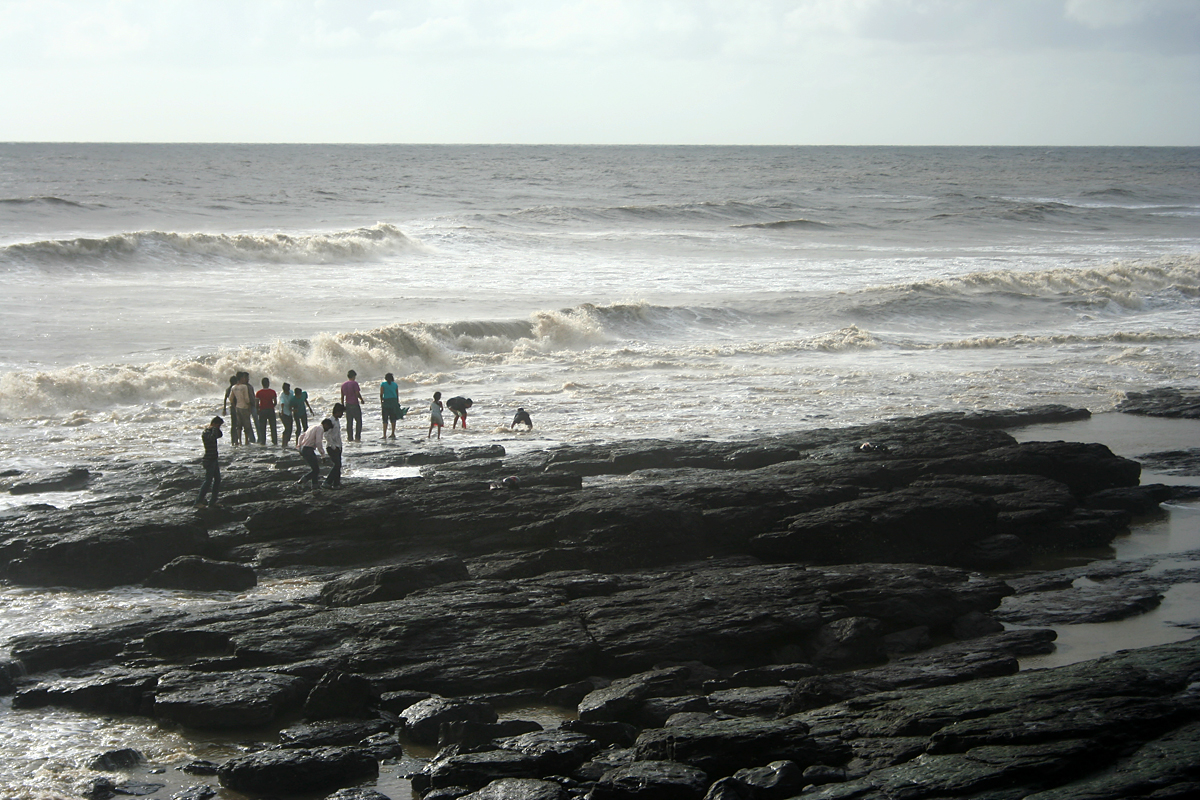
(Photo by A Kap on Flickr)
Nowhere is this more apparent than in my apartment complex. The playground is now a parking lot. And unfortunately, one of those cars standing there is mine.
Every time the water comes rushing in, I, and other car owners, rush with our cars out. We take our cars to higher ground and wade back through the water. Doing this during the day is bad enough, but I have had to do this late at night, and a couple of times at 4 am in the morning!
My apartment complex which would flood once a year now floods 4-5 times during the four-month monsoon season.
Every once in a while I am tempted to just let the car be. But three years back, after my car was partially submerged in water, my auto-mechanic warned me, “The insurance is covering the flood damage this time. But don’t park your car where it floods. We will charge you full price next time.” He said this while signing off on repairs worth 1,50,000 rupees!
Money may be a powerful motivator, but the thought of losing money is even more powerful. Since that day, I worry when the grey clouds gather over Mumbai. Every once in a while I head to my window – not to enjoy the shower and the cool breeze, but to keep an eye on water levels. I used to love falling asleep to the sound of heavy rains outside. No more. I cross my fingers and pray it doesn’t flood.
The prayer seems hollow because it seems to me that I am the illegal occupier and the sea the rightful owner. However, the modern generation of urban planners and engineers continue to their proud testosterone-fueled tradition. Floods be damned. Apartment complexes today simply raise their ground level to keep the cars safe.
I dream of moving into such an apartment one day. Of course, the easier thing to do would be to sell my car. I just want to enjoy – truly enjoy – the Mumbai rains once again.
Leave a Reply