• Writing in the AI age: More or Better

    Like many freelance writers, I am struggling to predict all the ways in which AI will affect my work – and how I can adapt to survive, even thrive, rather than become irrelevant. This can get rather overwhelming. But I believe wisdom lies in approaching such future-gazing like a jigsaw puzzle. While it will take a while for the full picture to emerge, parts of the new landscape will occasionally reveal themselves. Here’s one little nugget of insight. 

    I recently read a Substack Note by (presumably) a copywriter who managed to write a mind boggling number of blogposts, social media posts, newsletters, and other assorted creative assets in one month. I don’t remember the exact number, but the author claimed that the sheer volume of work would require a small agency to execute – and I was inclined to agree. Except this was produced and delivered by one writer who had developed a seemingly magical workflow that heavily deployed AI to deliver the work.

    Producing more is certainly one way for writers to survive the new reality. But what if instead of producing more, we were to focus on producing better

    For instance, let’s say, it took one writer 16 hours to produce one newsletter in the pre-AI world. Now, the writer can use AI tools to produce two newsletters that deliver similar levels of value and engagement. Or she could use AI tools to produce one newsletter in 16 hours – but with a higher degree of value and engagement. For instance, the writer could use ChatGPT’s Deep Research to weave in new data – and use Napkin.ai to produce a more engaging illustration.  

    Now, I can imagine that there will be clients who may not appreciate the better quality you produce. After all, the number of posts fits neatly into a spreadsheets in ways that quality does not. And so as writers we have a choice to make – to position ourselves as someone who uses AI to deliver more or better. 

    Maybe that’s the real jigsaw piece that clicked into place for me: This isn’t just about adapting a business model. It’s about deciding what kind of writer I want to be now that adaptation is no longer optional.

  • Why the first draft is about giving yourself a real problem

    Why the first draft is about giving yourself a real problem

    Nebulas, cosmic clouds made of gas and dust, are often referred to as star factories. Though there is nothing to grasp, these interstellar regions often give birth to stars.

    Ask any writer, and she’ll tell you that stories, too, take birth in the nebulas of the mind. To begin with, there is nothing but gas and dust – vague notions, fuzzy images, or perhaps a few fleeting ideas.

    And that makes writing a story’s first draft tricky. It’s like moulding air into shapes. There’s nothing to grasp!

    But there’s a way to take the pressure off. What if we thought of the first draft as a process to arrive at a ‘real’ problem? All you’re doing is adding water to the dust cloud, and your only aim is to end up with a wet lump of clay.

    It’s not much, but at least you can touch and feel it. And then, you can spin it on the potter’s wheel to create shapely stories.

  • And the Earth turns

    And the Earth turns

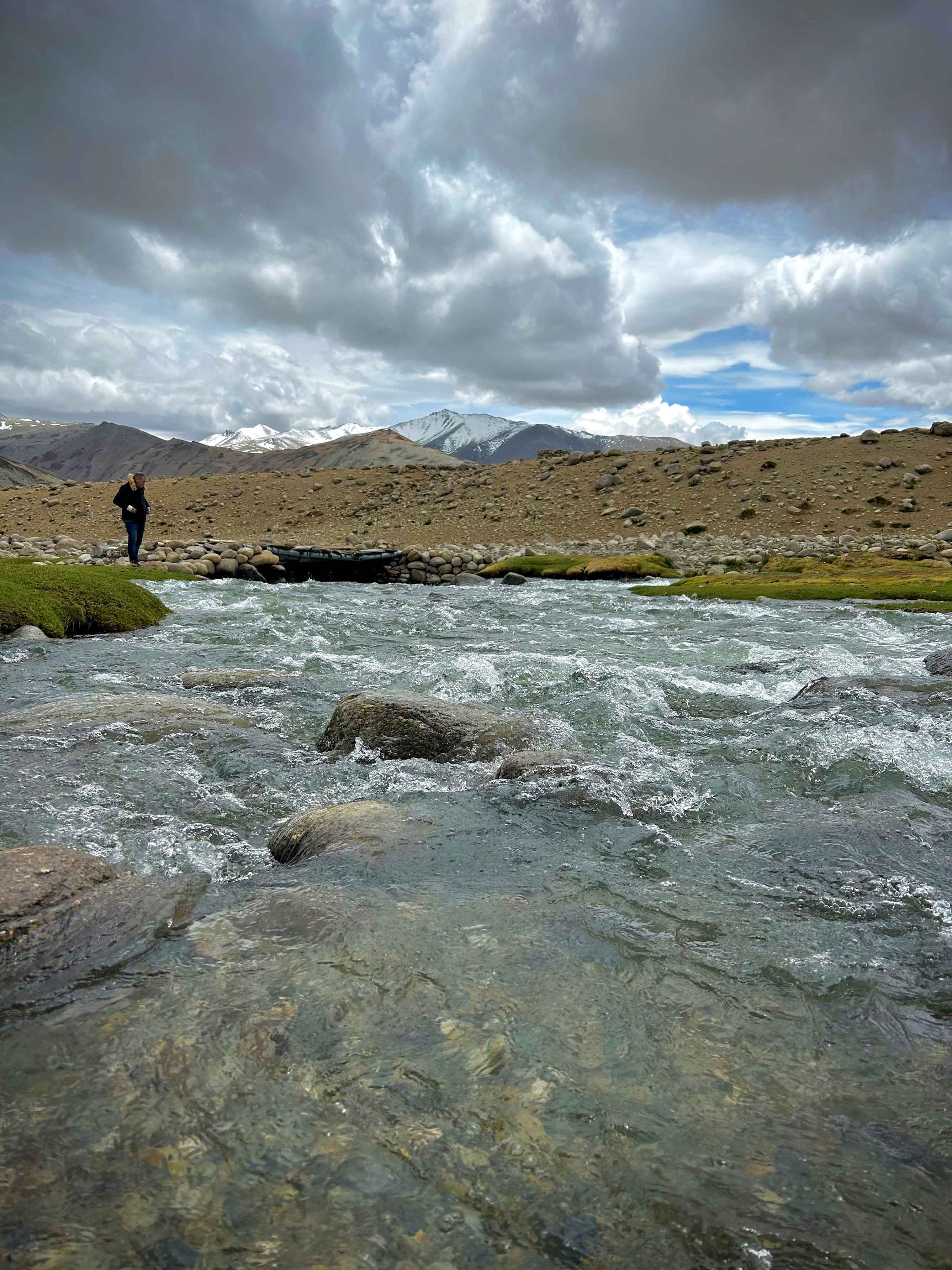
    Glaciers melt into scurrying streams
    Clouds rest in the folds of mountains
    Cows graze just below, on the slopes
    Delighting in the soft grass, 
    Garnished with early morning mist
    And the Earth turns

  • Don’t be your worst client

    Choose a project and think about what the perfect outcome would be.

    For example, if I am writing a novel, the perfect outcome would be a story with complex characters, delicious conflict, engaging dialogues, a plot with twists and turns, and an ending that ties it all up.

    Perfectionism wanted all this done yesterday. That’s why it is like the world’s worst client.

    Healthy Striving, on the other hand, is like the world’s best client – or at least a very good client. It’s about acknowledging the goal but also that there is a process to get there. It’s about knowing that the first draft is just that – the first draft. Instead of saying, “this doesn’t work,” it’s about figuring out why it doesn’t work and then brainstorming possible solutions.

    So, may be don’t be your own worst enemy – I mean, client.

  • Bombay from above

    Bombay from above

    I often wonder what Bombay would be like if the Britishers had left the seven (actually fourteen) islands alone. Sure, it wouldn’t be a metropolis. Instead, it would be a tropical paradise with marshes, beaches, rolling hills, fishing villages, and quaint little caves. 

    Of course, I wouldn’t have grown up here. It was Bombay’s industries and offices that drew millions of people to the city — among them my grandparents and parents.

    Over the years, my love for Bombay has waned. Like a child who grows up to notice the frailties of his parents he never noticed in childhood, I can see the cracks in this city. 

    But yesterday, I sat in a plane that hovered over the city for nearly half an hour. Round and round it went above the skies of South Bombay. Cyclone Biparjoy had briefly driven away the pollution that hovers over the city. And we were treated to clear views under the (hot) afternoon sun. 

    And my heart dropped a few thousand feet to meet the city below. Like an annoying child, I kept taking photos and showing them to my parents sitting beside me — “That’s Wankhede!” “There’s JNPT and Elephanta!” “Isn’t that the new trans harbour link!?” “That must be the Bandra Worli Sea Link!” 

    That’s the thing about love, isn’t it? When you love someone – or something – no matter how flawed they are, they’ll invoke this child-like delight in you. You see the flaws, and yet feel an almost primal love for the person – or, in this case, a city. 

  • A castle of sentences

    Lately, when I get stuck for words, I imagine I am standing in front of a closed door.

    All I need to do to open the door is write one sentence. The sentence may be short or long or awkward or angry or wise.

    It doesn’t matter.

    What matters is that it’s a sentence.

    As I step through the door, inside, I find something beautiful,

    Or scary, or soothing,

    Or boring, or nothing.

    It doesn’t matter.

    What matters is that I note what I find and look for the next door.

    I write another sentence,

    And that door opens.

    And then the next

    And then the next

    Until…

    I open the door that takes me outside.

    (Or, I’ve hit my deadline!)

    I step back and see,

    A castle of sentences.

  • Waiting for your Sierpiński triangle

    Waiting for your Sierpiński triangle

    Here’s a math lesson for creators! First, I’ll talk about the math and then the lesson for creators.

    The math

    I follow this excellent channel called Science is Fun on Instagram. The creator recently posted a video demonstrating a mathematical phenomenon called the Sierpiński triangle. (The original video is by Math Letters.)

    Start by placing three dots that form the vertices of an equilateral triangle. Make a dot randomly anywhere within the triangle. Now, place more dots by following two rules.

    1. You choose any one of the original three dots.
    2. Move towards the dot you’ve just placed, and at the midway point, drop another dot.

    Again, choose any one of the original three dots and move towards the latest dot you’ve placed and at the midway point drop a new dot.

    According to the video, if you do this thousands of times, a pattern will start to emerge called – you guessed it – the Sierpiński triangle.

    And now the lesson for creators

    Being a creator is like making a Sierpiński triangle. Every day, we show up and place a dot following a couple of rules. The individual dots look meaningless. There is no picture, nothing to appreciate. But place the dots enough number of times, and a pattern emerges. Not just a pattern but one of the most beautiful fractal patterns you’ll see.

    So, go ahead, place a dot. We’re waiting for your Sierpiński triangle.

  • Lean into the burn

    Lean into the burn

    Step-ups, Lat Pull Downs, Bent Over Rows, Cable Cross.

    There was a time when these phrases meant nothing to me. Sadly, these days I know. I not only know them, I live through them a few times a week.

    And it’s not enough to do them once. Ah, the cruel masters of the gym have deemed that hapless mortals repeat these actions multiple times. They try to make it sound cool by calling them reps. Multiple reps make up a set. And you need to do multiple sets. (!)

    Well, if you’re human, a few reps in, you’ll feel your muscles burn. The temptation, then, is to count down. Ten reps left. Nine reps left. Eight reps left… You get the idea.

    But this is a mistake.

    Because now my mind is focused only on finishing the set – avoiding the pain. And avoiding pain is like adding another 10 kilos on the machine. You suffer unnecessarily.

    Instead, I lean into the burn – focusing only on the rep I’m doing and nothing more. So, yes, I am experiencing pain – but less pain than if I were to try and countdown.

    I am discovering that the training helps when I swap the gym for my desk. When I’m staring at the blank screen instead of 25 kilos on the machine.

    I don’t rush to avoid the pain. Instead, I lean into the burn.

  • Intention and Expectation

    Every action has an associated intention and expectation.

    Sometimes intention and expectation are articulated by our minds. We know why we are taking an action and what we expect from it. But often, they are not. This may not always be a problem. However, if you find yourself struggling to act, it might be because your intention or expectation is focused on the result and not the process.

    A well-formed intention helps bring greater meaning to action. It might even make it more enjoyable. Expectation, on the other hand, is a speculation. It is best tamped down.  

  • How to keep your feet dry while walking in the rain

    How to keep your feet dry while walking in the rain

    I like walking in the rain, but I don’t like getting my feet wet. And if they do get wet, I don’t want them to stay wet.

    There are two things I can do: 

    1. Wear waterproof shoes that don’t let the water come in – but only as long as I don’t stay out too long. I also worry about my ankles, lest the water seeps in. Because once the water goes into a waterproof shoe, it stays wet for a long time. My skin goes wrinkly and red. And the shoe can’t be used until it dries from the inside.
    2. Wear a pair of shoes that invites the water in and lets it flow out quickly. I am no longer worried about keeping my feet dry. That battle is already lost. So, I walk at ease – not minding the grime because I can clean it off in a clean puddle. When I reach home, I wash my feet and pat them dry. I keep the shoes under the fan, and they dry in just a few hours.

    Turns out the best way to keep your feet (and shoes) dry in the rain is to let the water in.