Human beings have developed strange obsessions over the course of their evolution: Little pieces of paper, which are kept safely near the bum, light-emitting slabs of glass and plastic, and Taylor Swift.
One such obsession is with order and cleanliness. This is partly due to the fact that we have built ourselves tiny roofs and walls rather than live under the open sky. And so, we spend a small but not insignificant amount of time dusting and organising. We clear out cobwebs with extra gusto — ‘Damn those six-legged critters’.
For a long time, I used to do the same. Ants around the house were given the marching orders, cobwebs were introduced to the broom, and cockroaches were swiftly assassinated!
But at some point, I started thinking about how I could avoid the pests from coming into my home rather than killing them after.
I started questioning how much harm the beings we deem to be ‘pests’ actually cause us.
For instance, I avoid tempting the ants by clearing out sugar fallen on the kitchen platform immediately. If the ants do arrive, I let them carry out their operations as long as they don’t interfere with what I am doing. (They are usually very efficient about it.)
I felt vindicated when I read an essay by the poet Mary Oliver. In the essay, Oliver recalls her time in a rented house where she found a spider’s web under the staircase. Oliver’s power of observation and articulation is on full display as she describes the spider’s behaviour — from the trapping of a cricket to the laying of eggs.
But at one point, Oliver has to vacate the house. The owners, she knows, will clear out the spiders. In fact, Oliver herself has hired a crew to clean the house before handing it over to the owners. She considers moving the spider to a safer place.
Finally, I did nothing. I simply was not able to risk wrecking her world, and I could see no possible way I could move the whole kingdom. So I left her with the only thing I could—the certainty of a little more time. For our explicit and stern instructions to the cleaners were to scrub the house—but to stay out of this stairwell altogether.
But the line that stood out for me in the essay was this:
How do spiders know what they know?
When we casually kill an insect that does us no objective harm except disturbing our sense of order, are we aware that we are killing a being with knowledge? Who was born and strives to survive in this world as much as we do. Whose home this good earth is as much as our own.
I am not trying to judge anyone morally. I am sure more insects will die at my hands — certainly those that cause me harm and those that don’t. I am instead saying that we become more aware of our actions.
Meanwhile, there are multiple spider webs on the plants on my window. My hands itch to clear them with a broom. But I control my instincts. Like Oliver, I give the spiders the “certainty of a bit more time”.
If you liked this post, you can subscribe to my weekly newsletter with the best post(s) on leading a Calm, Creative, and Curious life.
Many meaningful goals require sustained, long-term effort, with little to no short-term results. Think about training for a marathon, setting up your own art show, losing weight, becoming a professional YouTuber, or, as in my case, writing a novel. (Not all meaningful goals are long, of course. Eating a cup of dark chocolate sundae is deeply meaningful, satisfying, and requires a short trip to the ice cream shop.)
Think of it this way. Someone tells you about a path that takes you to a beautiful destination. But the path itself is long. (No clue how long.) It has many twists and turns. It is deserted. The scenery is bleak on most days (though you might get flashes of stunning landscape now and again). There are no food stalls or coffee shops along the way (so no dark chocolate sundaes). And there is no GPS.
Sure you might start on the path and stay on it for a few days. But pretty soon you grow weary of it. You are scared, alone, and worst of all, bored. The destination is nowhere in sight! Inside you, a 6-year-old is crying out, “Are we there yet!”
In order to stick to the path, most of us need to feel motivated – we need to feel like we are making progress. One year – or even one month – is too long a time for us to wait for this cue.
In other words, we need to feel like we are making progress before the weighing scale shifts or before the first draft of the novel is written. The more frequently we receive this cue, the higher the chance we stay motivated. Because without motivation, we will fall back to our old patterns. (You know, take the exit at Netflix junction.)
But what measure should we choose as feedback? Writers often use ‘Daily Word Count’ as a measure of progress. Writing 500 or 1000 words constitutes progress and ‘success’ for the day.
I have tried this and it has not worked for me. Because there were days when the words flowed and I managed to put down 500 words on the page. But there were also days when I stared at the screen for an hour and generated a measly 200 words. On those days – that is, on most days – I felt like I had failed.
There is nothing wrong with receiving such negative feedback per se, but if you don’t hit the daily goals repeatedly, the message that goes out is, “You probably can’t do this.” If (or when) this happens it is likely you will step off the path.
After trying and failing with the ‘Daily Word Count’, I felt I needed a different way to measure progress.
For me, that measure is time-spent. Every time I sit down to write my novel, I start the timer for the project, on a time-tracking tool called Toggl. My goal is to work on my novel for 25 minutes every day. It doesn’t matter if I stare at the screen for 20 minutes and write for five. It doesn’t even matter if I sit there stewing in frustration without typing a word. As long as I spend 25 minutes (or even 15, because I, well, cheat), I feel like I have ‘worked on my novel’ for the day.
I know this may not sound convincing to many people. This may feel like a cop-out – an exercise in mediocrity. My own mind is first to voice such doubts. But you know what? I don’t care. All I want right now is to stick to the path. And right now, seeing that I am spending some time developing the novel is helping me stick to it. I have put words on the page, come up with (what I think are) interesting world rules. ‘Time spent’ is like a milestone that comes alive once in a day to give me pat on the back and whisper words of encouragement. It’s the succour I need on the stark, lonely path.
Fear comes in all kinds of flavours. One flavour that plays an important part in our lives – or at least in my life – is the fear of having regrets. We try our best to avoid making choices that we will regret later in life.
This makes sense. An executive who works weekends misses out on time spent with friends and family. Closer to or after retirement this individual may feel regret – because there are no more deadlines to pursue and your neglected relationships lie in a ditch.
Now, let’s come back to the present. Our executive is, say, 35. Why is he working all the time? Perhaps his priority is to earn a lot of money because he is desperate to have financial security. Maybe he is really good at his job and wants to grow creatively and financially.
In order to avoid regrets, this guy decides to take his weekends off to spend more time with his family. This choice does mean he won’t get enough work done. It might slow his career growth. Now, there is fear that he might regret not pushing himself enough to fulfill his potential.
In the present moment, either choice might lead to regret later in life.
Afraid of this our man pushes himself hard during the week. He tries to do well at work, spend time with family, nurture his hobbies, manage a side-hustle, and show up at the gym to maintain his fitness. Do you see where I am going with this?
Without the acceptance that there are some things we simply won’t be able to accommodate in our limited lives, every choice will lead to regret. We can cultivate this acceptance by first making space for some regrets in our lives. We don’t try to do it all. We prioritise.
Regrets indicate that we have lived a life where we made choices. And that the self who is making choices is imperfect (and it’s okay if he is imperfect). That he has simply made the best possible choice as per his current understanding of life.
Nature has many deliciously weird children. Take the giraffes. They stand on six-feet tall legs. They eat with mouths that are mounted on six-feet tall necks. And all this for what? Eat leaves on trees? The male giraffes do what males of any specie do with long appendages – have wicked fights. This is called – wait for it – necking. And don’t even get me started on their tongue!
However, one aspect of their lives which is downright boring is their social structure. Giraffes were considered aloof, without forming strong bonds that are seen in other African large mammals like elephants or lions – or so researchers thought until 2000.
Over the past couple of decades evidence is mounting in favour of giraffes having intricate social interactions. This year Zoe Muller and Stephan Harris from the University of Bristol released a paper that reviewed hundreds of giraffe studies. The paper summarises fascinating aspects of giraffes’s social lives.
They even form creches – wherein females take turns babysitting and feeding. (The mothers presumably take spa days to take a break from all the whining and diaper-changing.)
So why did biologists fail to notice these patterns earlier? Giraffes, after all, aren’t really hard to spot. As the New York Times reports, giraffe don’t communicate in ways that are obvious to humans. However, the use of digital cameras and spot pattern tracking is allowing researchers to make new connections that’s allowing us to uncover new behaviours.
Muller told the New York Times that this latest paper sets the stage for further research. For instance, female giraffes live beyond their child-bearing years. This is not common in the animal world. The hypothesis is that older females help with child-rearing – which again hints at giraffes having advanced social protocols.
So giraffes aren’t the social wallflowers we presumed them to be. Next time you are having a party, do send an invite to giraffes. But be warned, they may well bring their friends along, and they aren’t above necking in the open.
Chicory is the step-child in the universe of coffee purism. Some purists may react by saying that the Robusta bean is the step-child (more on this later) – which, would make chicory the dark sheep of the coffee universe? At this point, we would all agree that one of the many roads to hell is paved with labored metaphors and labels.
Suffice to say that here in India chicory is somewhat controversial. You feel like you need to look down upon it to be considered a person with good tastes – but damn does it make for a delicious cup of coffee! Think of it as Tyrion within the Lannister family. (I promise I am done with these comparisons!)
If you’ve ever had South Indian filter coffee (SIFC) then you’ve probably already had chicory. SIFC powders that you get in the market typically are a blend of coffee and chicory powders. The percentage of chicory can vary between 5-45%. Some brands declare the ratio on the pack – but not all do.
Growing up in a South Indian household, I was given the impression that chicory was a necessary evil – an adulterant in “pure” coffee to make the drink stronger. “We don’t buy coffee with too much chicory. Our powder has just 15% chicory,” a grand-uncle once told me, as we took a sip of coffee together.
This skepticism has deep roots, and to understand it we must first understand a few dominant principles in the coffee world.
A sketch of th chicory plant By Original book source: Prof. Dr. Otto Wilhelm Thomé Flora von Deutschland, Österreich und der Schweiz 1885, via Wikimedia Commons
Arabica and Robusta
First, there are two types of coffee beans that are sold commercially in the world – Arabica and Robusta.
Arabica beans are the premium variety. They are high on complex flavor compounds, have decent caffeine content, and lower amounts of the bad bitter compounds.
Robusta beans are more bitter, contain fewer complex flavor compounds, but they have higher caffeine when compared to Robusta (hence, “step-child”).
Purists have their coffee black with premium grade 100% Arabica beans. This is considered the gold standard. No one sells coffee powder made with 100% Robusta beans. (If they do I recommend you steer clear of such products – unless burnt rubber is the flavor you were going for.) However, Arabica+Robusta blends are commonly sold, and, in my opinion, make for a good cup of coffee.
A Wartime Substitute
While purists may tolerate Arabica+Robusta blends, chicory is considered an adulterant and downright frowned upon. There is truth to this assertion. After all, chicory is not coffee. It is a flowering plant and belongs to the dandelion family. Its fleshy white root is dug up, roasted, ground, and mixed with coffee powder to create a coffee+chicory blend.
In Europe and in the US, people turned to chicory when war disrupted coffee supply lines. Chicory was not the only substitute experimented with. There are records of people roasting chickpeas, cereals, and vegetables like beetroot to stretch their supplies of coffee!
In the book, Coffee and Chicory (1864), author P.L. Simmonds dedicates an entire chapter to coffee adulterants. He points out that bags of husks of peas, cobs of Indian corn, wheat, sea-biscuits and other articles, have no place in a coffee mill. In typically British fashion, Simmonds tries to be polite even as he disses on the adulterants.
It will not be denied that the husks of peas or the cobs of maize are appropriately placed in the trough from which our pigs feed; they will even add to the delicacy and whiteness of the pork those very useful animals are intended to yield us, but they are essentially out of place in our coffee-cup
Chicory: An Adulterant?
Interestingly, Simmonds doesn’t include chicory in the list of adulterants. But there are others that did. The entry on chicory in the Cyclopaedia of India And of Eastern and Southern Asia (1857) makes a reference to the Chambers’s Edinburgh Journal which states that “chicory must be regarded altogether as an adulterant”. The cyclopaedia also recommends a technique to find out if chicory is mixed with coffee.
The presence of chicory may be detected in coffee by putting a spoonful of coffee gently into a tumbler of clear cold water: if pure it will float on the surface; if not the chicory will separate and discolor the water as it subsides.
However, the market didn’t seem to care. According to Simmonds, France exported 1.25 million pounds of chicory in 1835. By 1860, they were exporting 16 million pounds per year. Ironically, this huge demand led to adulteration of chicory!
The great demand for chicory has led to extensive adulteration; first by what is called Hambro powder, which consists of roasted and ground peas, damaged corn &c. colored with Venetian red; and secondly by coffee flights , the thin membrane which separates from coffee seeds in the act of roasting.
Cyclopaedia of India And of Eastern and Southern Asia (page 340)
Parsnips and turnips too were roasted and used as substitutes for chicory.
The Counter View
What does the demand for chicory and its subsequent adulteration tell us? Chicory may have been added to coffee grounds to increase coffee volumes while supplies were low, but it clearly added something that was pleasing to the human palate.
According to Simmonds, the coffee-chicory mix probably had its origin in Holland, and was introduced in France at the beginning of the 19th Century. It was from there that chicory became popular.
Of course, the French were open to more experiments – adding roasted acorn and beetroots to their coffee mix. Simmonds mentions a recently introduced drink in France called ‘cafe de betterave’. The French believed that beetroots lent their nutrients and sweetness to coffee. The coffee+chicory mix was called ‘cafe de chicoree’.
In The History of Coffee Including a Chapter on Chicory (1850), author William Law describes just what chicory adds to coffee.
The truth seems to be,that Coffee is not what people call Coffee, unless a certain quantity of Chicory be prepared along with it; and it is rather remarkable that the world has been so long in getting at this fact. The Chicory seems to give body to the Coffee. It gives it also depth of colour; but that is nothing. It fortifies the quality of thinness in the Coffee, imparts that softish and pleasing aroma which makes the beverage acceptable.
What’s The Verdict?
This description of chicory solved a vexing puzzle in my head. Ten years ago, I wrote an article on the science of brewing the perfect cup of filter coffee. During an interview, the former head of quality control at the Coffee Board of India told me that it was possible to make a good cup of filter coffee using just Arabica beans.
I was excited. I bought a (rather expensive) pack of coffee powder made with 100% Arabica beans. But the excitement died the moment I took the first sip. It tasted of coffee alright. But there were two problems:
It was too white
It was watery.
I noticed the brew itself was watery when compared to the brew made with coffee+chicory blend. I tried varying the amount of coffee powder used. But the brew continued to be thin. Either I was wrong or 100% Arabica beans simply couldn’t yield a classic cup of SIFC.
But as Law’s description notes, chicory adds color and “fortifies the thinness in coffee”. What this means is that chicory plays a critical role giving South Indian Filter Coffee its signature color, mouth-feel, and aroma.
But The Argument Continues
However, coffee planters in India vehemently disagree with this view. They fear that much of coffee sold in India is adulterated with a lot of chicory. In a 2017 article in the Deccan Chronicle, a coffee planter, GB Bhoje Gowda rued, “Adding chicory makes coffee thicker, but does nothing for its taste. Even without chicory coffee can be thicker if extra milk is added.” Further in the article, Gowda even calls for a ban on chicory.
This position is not new. As Law notes in his book which was published in 1850, coffee planters believed that chicory was destroying their trade. Two years after Law’s book was published, chicory was indeed banned by the British government. This move was criticised by Charles Dickens in an essay titled Justice for Chicory (page 209). He advocated that chicory should not be added to coffee in secret, but openly. Dickens argued that those who had finer tastes and the money to buy premium coffee could choose to avoid chicory. However, for those who couldn’t afford to buy expensive coffee, the addition of chicory could elevate the flavour of cheaper coffee.
We would also follow the sage advice included in the Cyclopaedia of India And of Eastern and Southern Asia, which states that roasted chicory powder should not be pre-mixed with coffee, but should rather be sold separately – leaving it up to the buyers to decide how much chicory they wish to add.
So, now, while I do enjoy black coffee made with 100% Arabica beans using the pour-over method of brewing, I have a new respect for chicory. If you are still on the fence, you can remind yourself of the French hand in this humble ingredient’s rise in popularity. Or that chicory was championed by Charles Dickens himself!
In other words, chicory is nothing to sniff at – and if you do, all you will experience is a pleasant aroma.
Starting new projects and watching them fall by the wayside is a fact of modern-day life. I say modern-day because it is extremely easy to start something new today. In the 18th Century, you’d have to be really motivated to enroll in a doodling class and then start a webcomic series on Instagram. For one, you’d be living in a village and would have had to walk 20 kilometers to the nearest town to attend the class. More importantly, you’d have to wait 300 years for the internet and then Instagram to be invented.
Today, I log in to a website, pay money via a plastic card, and attend the class. Or to be more precise I watch the first two videos of the class, and then reward myself by falling down the rabbit hole that is Netflix.
While some of these endeavors are destined for the ditch (like my ill-fated attempt to learn Python programming), there are others that nag at me. These are persistent, and refuse to let me go – much like distant relatives at an Indian wedding.
Such endeavors deserve my attention because they resonate with me. For me, this includes writing regularly and learning how to doodle. But it also includes stuff like exercising, maintaining my meditation practice, eating healthy. (I include these side projects because no one is paying me to do them. The only reason to do it is that they’re good for me.) But just because these things are important to me, doesn’t mean they (or I) won’t veer off the path with annoying frequency.
I have realized that the problem isn’t that they veer off the path. It’s like expecting a toddler to sit at one place and eat their dinner. The problem is that I feel extremely bad when I do deviate or fail.
I have written earlier on the virtues and mechanics of restarting. What I want to talk about here is how soon we should restart — or in other words press reset after fucking up something.
To start again, all you need to do is hit reset. The sooner the better. Photo by Veri Ivanova on Unsplash
So let’s say my goal is to exercise 4 days a week. It’s Thursday evening. Your exercise scorecard stands at a grand total of 0. You have clearly failed. Now the question: When do you hit reset?
‘Next Monday’ is a perfectly reasonable answer.
But if we hit the reset button sooner, we can exercise Friday and Saturday. (Take a rest on Sunday. You deserve it slugger.) Because 2/4 is better than 0/4. And then start on Monday aiming for 4/4.
My argument is that without those imperfect scores of 1/4 or 3/4, we are never going to reach a place where we hit 4/4.
Similarly, if you had a New Year’s resolution to eat healthy, and have failed so far, start a July resolution to eat healthy for the next 5 months. And if you fail after a couple of days, start again right then and there. Don’t wait for January to hit reset.
This is simple enough to understand, but very difficult to implement. Years of conditioning make us set these arbitrary units of time — in terms of years, months, weeks, and days.
But what if we give ourselves the permission to reset at any given moment? Even if we fail — which we will — we give ourselves the chance to get back on track as soon as possible.
Fail Fast is the productivity paradigm that many tech companies have used to build meaningful products. I would like to add a corollary to it: Fail Fast. Reset Faster.
Social Media has revealed to me an important facet of the human psyche. It occurs to me that no matter what race, gender, or religion we belong, we have one thing in common: We are all a bunch of pouty 13-year-olds, who are convinced about the sanctity of our own opinions.
Most of us love to take a grain of knowledge and spin opinions that are as pretty and fluffy, as cotton candy — and about as nutritious. We love airing them to anyone who will listen – and even people who don’t want to listen. We love defending them from “the haters” and “trolls”. (Never mind the fact that trolls live happily in their Scandinavian caves – their happiness rooted in the fact that their thick cave walls block out wireless connections and by extension the internet.) And we love dissing the opinions we don’t agree with – turning into trolls ourselves. (Again, my deepest apologies to the actual trolls, who I am sure are a lovely race.)
But there is a special place in Twitter hell reserved for people who change their stance or are proved wrong on an issue. (One could also argue quite convincingly that all Twitter is hell.)
Don’t get me wrong. I love it when news anchors or politicians are made to chew their own words. But dissing people when they change their stance, sends out the wrong message to the wider tribe.
I have taken part in and observed many a passionate opinion slog fest. However, half an hour into an argument, a sense of disorientation sets in. I am not sure what we are trying achieve anymore.
What started as a discussion shapeshifts into a debate, which shapeshifts into an argument, which shapeshifts into a screaming match, which shapeshifts ultimately into a pouty 13-year-old, who cares only about one thing – being right.
There is no space to admit I might be wrong. Because in a combative environment, admitting one might be wrong means defeat. And we certainly do not like feel defeated.
I have noticed this in others and I have noticed this in myself. All I want to do is tell the 13-year-old that it’s okay if you’re wrong. That the sky won’t come crashing down on you if you admit that you never should’ve worn that eyesore of a stone washed, ripped jeans.
We need to create a world where it’s okay for people to come out and admit that they were wrong. A world in which changing an opinion will not be met with derision from the tribe. Because even the best and noblest among us are, in fact, imperfect apes, who can only get better if they’re given the room to change their opinions.
History nerds love What-If questions. One of my favourite What-Ifs is this: What if the Portuguese hadn’t stumbled upon a group of seven islands with a calm harbour on the Western coast of India, which proved to be a good parking spot for their boats and ships?
Would the bay and the seven islands in the area remain in their original shape? Would the rolling hills be covered with tropical trees even now? Would there be ferry services bringing tourists in from the mainland to this tropical paradise? Would there be a sea-facing restaurant on the island of Mahim, where you could sip lemongrass chai and gaze upon the island of Worli and Salsette?
A rendering of the seven islands of Bombay. These do not include the city’s suburbs. The island peeking in from the upper left corner is Salsette. The area seen in the image above is called Bandra. By TIFR, Nichalp – TIFR, CC BY-SA 3.0, https://commons.wikimedia.org/w/index.php?curid=4580120asj
By 1893 Bombay was on its way to become the monolith it is today. Salsette which forms a big chunk of Mumbai’s suburbs still hasn’t merged with the city. If you peer closely, you will make out the island of Versova in the upper left area of the map. My apartment complex would come up somewhere in this area 85-90 years later. ((By J.G. Bartholomew, Archibald Constable and Company – Constable’s Hand Atlas of India, 1893 edition, Public Domain, https://commons.wikimedia.org/w/index.php?curid=7059758)
As it turned out, the Portuguese did discover the bay. They called it Bom Bahia, or good bay, which eventually became Bombay and later, Mumbai. The British took over in the late 17th Century. Then a team of what I can only assume were testosterone-fueled engineers and urban planners went to work on the islands. They filled up the spaces between them with the vigour of a dentist closing cavities.
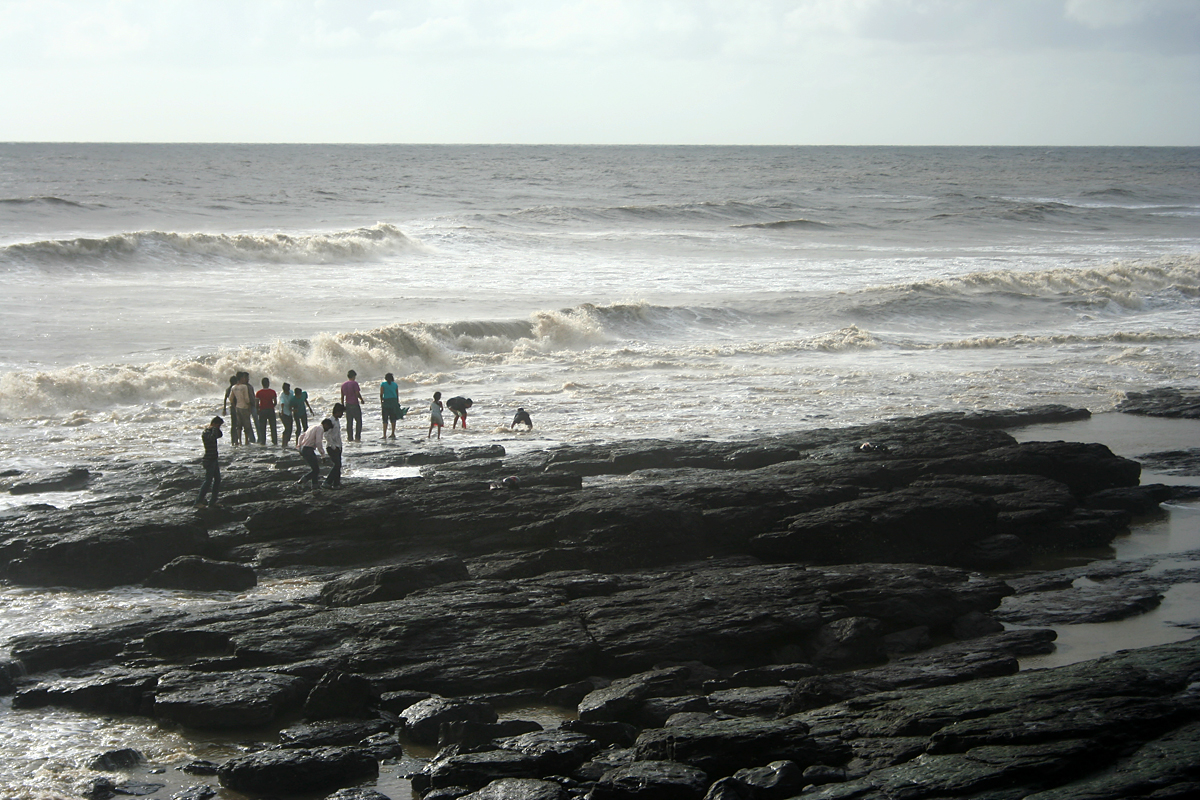
By the time I was born – over three centuries after the British took over – Bombay was a monolith. A single island. The city grew in prominence largely because of its harbour. But the Arabian Sea that lapped Mumbai’s shores was never too happy with the arrangement. Every year, aided by monsoon, the sea would invade the land and temporarily lay claim to what in all honesty was her ancestral home.
Growing up in Mumbai, this did not bother me in the least. I loved the monsoon season. It coincided with the start of a new school year. A time of new textbooks, fresh uniforms, and spirits unsullied by poor marks that would follow later in the year. It was also the season of roasted corn on handcarts. Of plums, peaches, litchis, and jamuns.
But what I loved most about the monsoon season was the floods. As I remember it, in the 1990s, Mumbai would grind to a halt at least once during the monsoon season. Our apartment complex, which is built on low-lying land (or perhaps reclaimed land) in Mumbai’s suburbs, would be filled with knee-height or waist-height water.
In the blissful age before the internet, thoughts of leptospirosis and other assorted waterborne diseases never occurred to me, my friends, or our parents. All the kids in the complex would wade through the water secure in the knowledge that there would be no school the next day. We would wait by the road for a hapless vehicle to pass by – enjoying the waves they left in their wake, which reminded us of the nearby Juhu beach.
Sometime during the afternoon, the power would invariably cut off. But we didn’t care. It was raining and there was a temporary swimming pool in our society playground. Candles would be lit in the evening. The power would come back on late in the night. The flood was over.
I realise now that I was in a position of privilege to thus enjoy the floods. My peers who lived in slums or out on the road wouldn’t have seen the floods in the same light. For them, it would’ve meant sleepless nights and the washing away of their precious earthly possessions.
The only time I remember being afraid was when my mom did not return home the whole night. She had left from her workplace in Worli on the office bus. But there was no sign of her late into the night. A few of my friends in the complex too had parents who traveled by the same bus. So the tension was collective.
Finally, at 3 am, the gang of moms trooped into the apartment complex. There was a collective sigh of relief.
I grew up, got hooked to the internet, and learned about leptospirosis and other assorted water-borne diseases. I refrained from stepping out into the floods unless necessary.
Then, on July 26, 2005, Mumbai received many million bucket loads of rain (official figures put it at 944mm of rain in 24 hours). The crimes of all our past testosterone-fueled urban planners and engineers came to roost. The Mithi River – which runs from the Powai hills to Mahim – especially had had enough of all the reclamation wrought upon it as it swallowed up many suburban areas it passed through.
On that day, I left office and waded through chest-high water for nearly 5 kilometers, to reach a friend’s home. (My own home was some 25 kilometers away and quite impossible to reach.) Thousands of my fellow Mumbaikars trekked through flooded streets and highways for over 50 kilometers to reach the safety of their homes. The death toll was between 1,000 to 5,000.
The city as a whole was traumatised. After 2005, I noticed that Mumbaikars, who were usually fearless in the face of rains, would get worried if it poured for more than 4-5 hours at a stretch.
But I still loved the monsoon season. I would take a few hours off from work to visit the Worli sea face to enjoy the weather. The trip would end with a hot cup of chai and vada pav.
However, over the past decade, I have seen a shift in Mumbai’s weather patterns. (A shift in the weather pattern is a glacial process. To witness such a tangible shift in one’s lifetime – let alone a decade – is deeply significant.) The 2005 floods may have been written off as a one-off event, but the frequency with which the municipal authorities issue Red and Orange alerts in the city has been increasing steadily. Two cyclones have passed close to Mumbai in the last two years. Instead of flooding once a season, Mumbai floods at least 2-3 times.
Spot the cars! The sea continues to invade Mumbai – growing stronger every year. This photo appears to have been taken in 2008. (Photo by A Kap on Flickr)
Nowhere is this more apparent than in my apartment complex. The playground is now a parking lot. And unfortunately, one of those cars standing there is mine.
Every time the water comes rushing in, I, and other car owners, rush with our cars out. We take our cars to higher ground and wade back through the water. Doing this during the day is bad enough, but I have had to do this late at night, and a couple of times at 4 am in the morning!
My apartment complex which would flood once a year now floods 4-5 times during the four-month monsoon season.
Every once in a while I am tempted to just let the car be. But three years back, after my car was partially submerged in water, my auto-mechanic warned me, “The insurance is covering the flood damage this time. But don’t park your car where it floods. We will charge you full price next time.” He said this while signing off on repairs worth 1,50,000 rupees!
Money may be a powerful motivator, but the thought of losing money is even more powerful. Since that day, I worry when the grey clouds gather over Mumbai. Every once in a while I head to my window – not to enjoy the shower and the cool breeze, but to keep an eye on water levels. I used to love falling asleep to the sound of heavy rains outside. No more. I cross my fingers and pray it doesn’t flood.
The prayer seems hollow because it seems to me that I am the illegal occupier and the sea the rightful owner. However, the modern generation of urban planners and engineers continue to their proud testosterone-fueled tradition. Floods be damned. Apartment complexes today simply raise their ground level to keep the cars safe.
I dream of moving into such an apartment one day. Of course, the easier thing to do would be to sell my car. I just want to enjoy – truly enjoy – the Mumbai rains once again.
Meditation has become somewhat of a buzz word in recent years, aided in no small part by the proliferation of apps that offer guided meditations. As more people get introduced to meditation via these apps, the understanding and misunderstanding around the practice appears to be growing.
Some meditation teachers are concerned that the apps offer a limited or skewed understanding of meditation. A case in point: Many apps offer guided meditations to be done at bedtime that can help people get a good night’s sleep.
I visited the App Store listing pages of Calm and Headspace – two of the most popular meditation apps. The pages have featured images where developers communicate their apps’s best features to users.
On Calm, the second featured image reads, ‘Sleep more. Stress less. Live better.’ Ditto Headspace, whose second featured image says, ‘Sleep soundly. Stress less.’ Clearly, these apps are presenting a good night’s sleep as a key value proposition to potential users.
There is nothing wrong in presenting or following the apps’s ‘bedtime’ offerings. But according to me they are not meditation practices. They are relaxation techniques.
(Note: I do not claim to be a meditation master. My understanding is based on my own practice, reading books, and listening to talks by meditation masters such as Sam Harris, Mingyur Rinpoche, Jack Kornfield, Diana Winston and Tara Brach.)
The purpose of relaxation techniques is to, well, relax your mind and body.
On the other hand, the purpose of meditation practices – and yes, there are multiple practices – is to develop a clarity in understanding the nature of reality.
A good way to achieve this is to develop a better understanding of our minds and hearts. We must also understand the nature of suffering. In the process, we feel calmer and more grounded. These are all positive emotions – but none are meant to lull you to sleep.
I want to clarify that I find relaxation techniques extremely useful in my own life. However, what I do want to point out is that the scope of meditation practices is much wider.